The full list, pathway by pathway
Y rhestr lawn, llwybr wrth lwybr
Every form, check-in and screening instrument Holdfast supports
Pob ffurflen, gwiriad ac offeryn sgrinio y mae Holdfast yn eu cefnogi
Every pathway runs the same short check-in, and clinicians can layer published PROMs and screeners on top. Everything is scored by the same engine, on the same caseload, in the same audit log.
Mae pob llwybr yn rhedeg yr un gwiriad byr, a gall clinigwyr ychwanegu PROMs a sgrinwyr cyhoeddedig ar ei ben. Caiff popeth ei sgorio gan yr un peiriant, ar yr un llwyth achosion, yn yr un cofnod archwilio.
Two kinds of instrument, one check-in screen
Dau fath o offeryn, un sgrin wiriad
Regular check-in (PROM) instruments repeat on a set cadence, and their trend feeds the risk engine - a PHQ-9 or GAD-7 climbing between rounds can raise a review on its own. One-off screeners are requested for a specific reason and recorded as their own result. Any screener can be requested for any patient - the pathway column below shows the default use, not a hard restriction.
Mae offerynnau gwiriad rheolaidd (PROM) yn ailadrodd ar gyflymder penodol, ac mae eu tueddiad yn bwydo'r peiriant risg - gall PHQ-9 neu GAD-7 sy'n dringo rhwng rowndiau godi adolygiad ar ei ben ei hun. Gofynnir am sgrinwyr untro am reswm penodol ac fe'u cofnodir fel eu canlyniad eu hunain. Gellir gofyn am unrhyw sgriniwr ar gyfer unrhyw glaf - mae'r golofn llwybr isod yn dangos y defnydd rhagosodedig, nid cyfyngiad caeth.
- Patient (self-report)Claf (hunanadroddiad)
- Parent / carerRhiant / gofalwr
- Staff-administeredWedi'i weinyddu gan staff
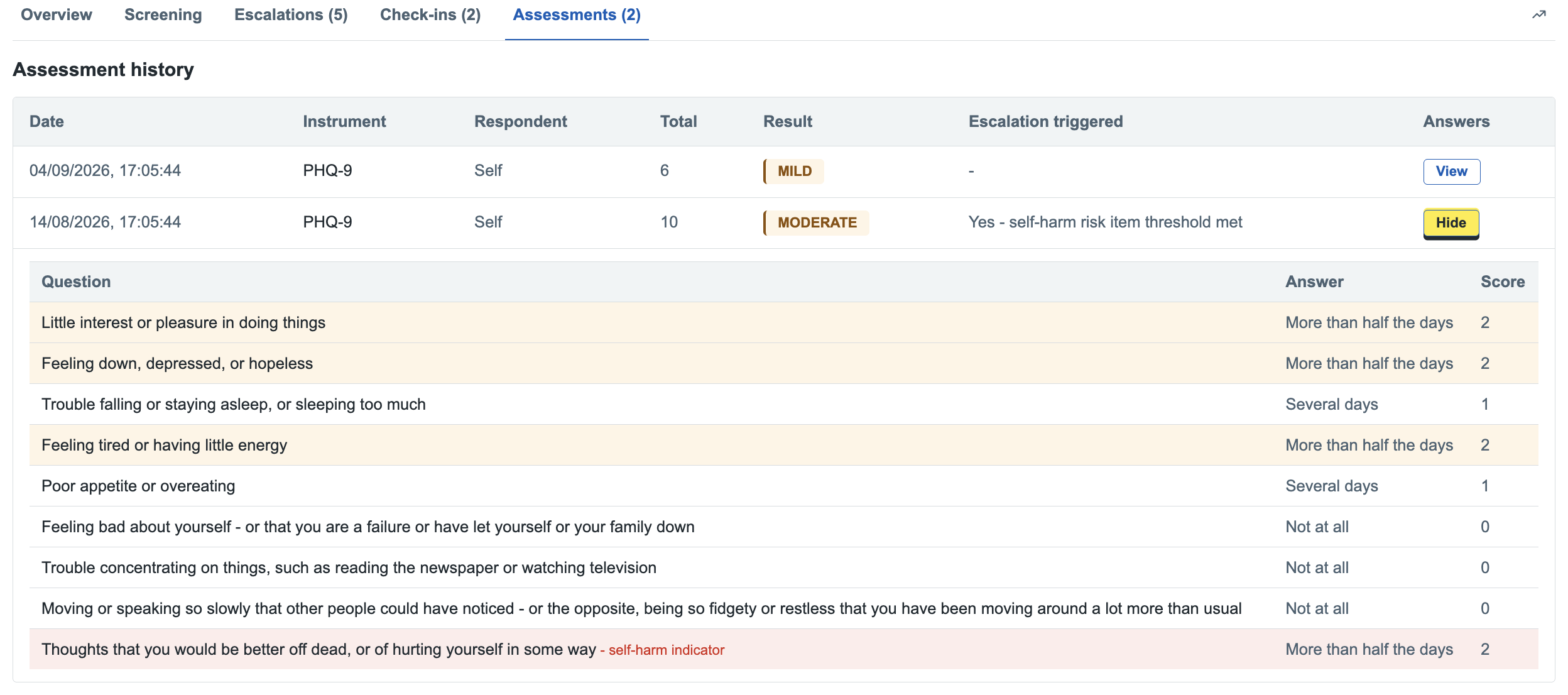
How a completed result reads
Sut mae canlyniad wedi'i gwblhau yn darllen
Every result is stored with its full item-by-item breakdown - each question, the answer given, its score, and the total with its severity band. Named high-risk items, such as the PHQ-9 self-harm question, are flagged in the answer table and the result records whether they triggered an escalation and why.
Caiff pob canlyniad ei storio gyda'i ddadansoddiad llawn fesul eitem - pob cwestiwn, yr ateb a roddwyd, ei sgôr, a'r cyfanswm gyda'i fand difrifoldeb. Caiff eitemau risg uchel enwedig, fel cwestiwn hunan-niwed y PHQ-9, eu fflagio yn y tabl atebion ac mae'r canlyniad yn cofnodi a wnaethant sbarduno dwysâd a pham.
The library
Y llyfrgell
| Form / instrument Ffurflen / offeryn | What it's for Ei ddiben | Type Math | Completed by Wedi'i gwblhau gan |
|---|---|---|---|
| Every pathway Pob llwybr | |||
| Standard check-in Gwiriad safonol | Short mood, sleep and risk items on the cadence a clinician sets. Feeds the deterministic risk engine directly, alongside whichever PROM the pathway uses. Eitemau byr ar hwyliau, cwsg a risg ar y cyflymder y mae clinigwr yn ei osod. Yn bwydo'r peiriant risg penderfynol yn uniongyrchol, ochr yn ochr â pha bynnag PROM y mae'r llwybr yn ei ddefnyddio. | Regular check-in Gwiriad rheolaidd | Patient / carer Claf / gofalwr |
| Mental health Iechyd meddwl | |||
| PHQ-9 PHQ-9 | Patient Health Questionnaire-9 - depression severity. The default depression PROM on every pathway unless replaced by EPDS (Perinatal) or GDS-15 (Older adult). Holiadur Iechyd Claf-9 - difrifoldeb iselder. Y PROM iselder rhagosodedig ar bob llwybr oni chaiff ei ddisodli gan EPDS (Cyfnod Amenedigol) neu GDS-15 (Oedolyn hŷn). | Regular check-in (PROM) Gwiriad rheolaidd (PROM) | Patient Claf |
| GAD-7 GAD-7 | Generalized Anxiety Disorder-7 - anxiety severity, repeated on the same cadence as PHQ-9. Anhwylder Pryder Cyffredinol-7 - difrifoldeb pryder, yn cael ei ailadrodd ar yr un cyflymder â PHQ-9. | Regular check-in (PROM) Gwiriad rheolaidd (PROM) | Patient Claf |
| CORE-10 CORE-10 | Clinical Outcomes in Routine Evaluation-10 - general psychological distress, requested when a broader distress measure is needed alongside PHQ-9/GAD-7. Deilliannau Clinigol mewn Gwerthusiad Arferol-10 - gofid seicolegol cyffredinol, y gofynnir amdano pan fo angen mesur gofid ehangach ochr yn ochr â PHQ-9/GAD-7. | One-off screener Sgriniwr untro | Patient Claf |
| WSAS WSAS | Work and Social Adjustment Scale - how much a problem is impairing day-to-day functioning. Graddfa Addasu Gwaith a Chymdeithasol - faint y mae problem yn amharu ar weithrediad o ddydd i ddydd. | One-off screener Sgriniwr untro | Patient Claf |
| AUDIT-C AUDIT-C | Alcohol Use Disorders Identification Test (Consumption) - a three-question alcohol-use screen. Prawf Adnabod Anhwylderau Defnyddio Alcohol (Defnydd) - sgrin defnydd alcohol tri chwestiwn. | One-off screener Sgriniwr untro | Patient Claf |
| Adult ADHD ADHD Oedolion | |||
| ASRS ASRS | Adult ADHD Self-Report Scale (Part A) - screens for adult ADHD while someone waits, often years, for assessment. Graddfa Hunanadrodd ADHD Oedolion (Rhan A) - yn sgrinio ar gyfer ADHD oedolion tra bod rhywun yn aros, yn aml am flynyddoedd, am asesiad. | One-off screener Sgriniwr untro | Patient Claf |
| Child ADHD ADHD Plant | |||
| SNAP-IV SNAP-IV | 26-item child ADHD rating scale, completed by a parent or carer through their own scoped login. Graddfa raddio ADHD plant 26 eitem, wedi'i chwblhau gan riant neu ofalwr drwy eu mewngofnodi cwmpasedig eu hunain. | One-off screener Sgriniwr untro | Parent / carer Rhiant / gofalwr |
| Autism Awtistiaeth | |||
| AQ-10 (adult) AQ-10 (oedolyn) | Autism Spectrum Quotient-10 - self-report autism screen for ages 16+. Cyniferydd Sbectrwm Awtistig-10 - sgrin awtistiaeth hunanadrodd ar gyfer 16 oed a hŷn. | One-off screener Sgriniwr untro | Patient Claf |
| AQ-10 (adolescent) AQ-10 (glaslanc) | Same AQ-10 screen, worded for a parent/carer describing a young person aged 12-15. Yr un sgrin AQ-10, wedi'i geirio ar gyfer rhiant/gofalwr sy'n disgrifio person ifanc rhwng 12-15 oed. | One-off screener Sgriniwr untro | Parent / carer Rhiant / gofalwr |
| AQ-10 (child) AQ-10 (plentyn) | Same AQ-10 screen, worded for a parent/carer describing a child aged 4-11. Yr un sgrin AQ-10, wedi'i geirio ar gyfer rhiant/gofalwr sy'n disgrifio plentyn rhwng 4-11 oed. | One-off screener Sgriniwr untro | Parent / carer Rhiant / gofalwr |
| Eating disorder Anhwylder bwyta | |||
| Standard check-in + physical-risk items Gwiriad safonol ac eitemau risg corfforol | The same standard check-in, with extra MEED (Medical Emergencies in Eating Disorders) physical-risk items added directly to it - no separate form to fill in. Yr un gwiriad safonol, gydag eitemau risg corfforol MEED ychwanegol (Argyfyngau Meddygol mewn Anhwylderau Bwyta) wedi'u hychwanegu'n uniongyrchol ato - dim ffurflen ar wahân i'w llenwi. | Regular check-in Gwiriad rheolaidd | Patient Claf |
| Perinatal Cyfnod Amenedigol | |||
| EPDS EPDS | Edinburgh Postnatal Depression Scale - replaces PHQ-9 as the depression PROM for anyone pregnant or recently postpartum. Graddfa Iselder Ôl-enedigol Caeredin - yn disodli PHQ-9 fel y PROM iselder ar gyfer unrhyw un sy'n feichiog neu newydd esgor. | Regular check-in (PROM) Gwiriad rheolaidd (PROM) | Patient Claf |
| Older adult & memory services Oedolion hŷn a gwasanaethau cof | |||
| GDS-15 GDS-15 | Geriatric Depression Scale-15 - replaces PHQ-9 as the depression PROM for older adults. Graddfa Iselder Geriatrig-15 - yn disodli PHQ-9 fel y PROM iselder ar gyfer oedolion hŷn. | Regular check-in (PROM) Gwiriad rheolaidd (PROM) | Patient Claf |
| 6-CIT 6-CIT | 6-Item Cognitive Impairment Test - a short cognitive screen talked through with a member of staff, including a name-and-address recall step. Prawf Nam Gwybyddol 6 Eitem - sgrin wybyddol fer a drafodir gydag aelod o staff, gan gynnwys cam adalw enw a chyfeiriad. | One-off screener Sgriniwr untro | Staff-administered Wedi'i weinyddu gan staff |
| DAST-10 DAST-10 | Drug Abuse Screening Test-10 - a drug-use comorbidity check (excluding alcohol and tobacco). Prawf Sgrinio Camddefnyddio Cyffuriau-10 - gwiriad cyd-forbidrwydd defnydd cyffuriau (heb gynnwys alcohol a thybaco). | One-off screener Sgriniwr untro | Patient Claf |
| Trauma & PTSD Trawma a PTSD | |||
| TSQ TSQ | Trauma Screening Questionnaire - a quick post-trauma triage flag, picked by the clinician over the fuller PCL-5 when that's all that's needed. Holiadur Sgrinio Trawma - fflag frysbennu ôl-drawma cyflym, y mae'r clinigwr yn ei dewis dros y PCL-5 llawnach pan mai dyna'r cyfan sydd ei angen. | One-off screener Sgriniwr untro | Patient Claf |
| PCL-5 PCL-5 | PTSD Checklist for DSM-5 - full PTSD severity detail, picked by the clinician over the shorter TSQ when it's needed. Rhestr Wirio PTSD ar gyfer DSM-5 - manylion difrifoldeb PTSD llawn, y mae'r clinigwr yn ei dewis dros y TSQ byrrach pan fo'i angen. | One-off screener Sgriniwr untro | Patient Claf |
| DAST-10 DAST-10 | Same drug-use comorbidity screen as on the older-adult pathway, requested alongside a trauma referral. Yr un sgrin gyd-forbidrwydd defnydd cyffuriau â'r llwybr oedolion hŷn, y gofynnir amdani ochr yn ochr ag atgyfeiriad trawma. | One-off screener Sgriniwr untro | Patient Claf |
Adding a pathway means configuring which instruments it uses, not building a new questionnaire. See how a clinician requests a one-off screener, or how a carer completes an instrument on a child pathway.
Mae ychwanegu llwybr yn golygu ffurfweddu pa offerynnau y mae'n eu defnyddio, nid adeiladu holiadur newydd. Gweler sut mae clinigwr yn gofyn am sgriniwr untro, neu sut mae gofalwr yn cwblhau offeryn ar lwybr plentyn.
Beyond scored instruments
Y tu hwnt i offerynnau sy'n cael eu sgorio
Referral packs: ADHD & Autism assessment requests
Pecynnau atgyfeirio: ceisiadau asesu ADHD ac Awtistiaeth
For adult ADHD and Autism, the referral is the first bottleneck, not the instruments. Most Trusts require a long paper-style pack, including one completed by someone who has known the person since childhood. Holdfast digitises that pack as an optional, per-ICB extra, reusing the ASRS and AQ-10 results.
Ar gyfer ADHD oedolion ac Awtistiaeth, yr atgyfeiriad yw'r rhwystr cyntaf, nid yr offerynnau. Mae'r rhan fwyaf o Ymddiriedolaethau'n gofyn am becyn hir ar ffurf papur, gan gynnwys un wedi'i gwblhau gan rywun sydd wedi adnabod y person ers plentyndod. Mae Holdfast yn digido'r pecyn hwnnw fel ychwanegiad dewisol fesul ICB, gan ailddefnyddio canlyniadau ASRS ac AQ-10.
Patient completes their half
Y claf yn cwblhau eu hanner
The patient (or a support worker, on their behalf) fills in the structured pack over more than one sitting, with autosave, exactly how people complete these packs in practice today.
Mae'r claf (neu weithiwr cymorth, ar eu rhan) yn llenwi'r pecyn strwythuredig dros fwy nag un sesiwn, gydag arbed-awtomatig, yn union fel y mae pobl yn cwblhau'r pecynnau hyn yn ymarferol heddiw.
Informant completes theirs
Yr hysbysydd yn cwblhau eu rhan hwy
A parent, sibling or friend who has known the patient since childhood completes their half through a secure, single-use link. No account, login or dashboard; the link is the only credential.
Mae rhiant, brawd neu chwaer, neu ffrind sydd wedi adnabod y claf ers plentyndod yn cwblhau eu hanner drwy ddolen ddiogel, untro. Dim cyfrif, mewngofnodi na dangosfwrdd; y ddolen yw'r unig gymhwyster.
Staff export and track
Staff yn allforio ac yn olrhain
Staff track the pack's status end to end, export the completed pack (with the linked ASRS/AQ-10 result attached) to send on to the specialist service, and record the outcome when it comes back.
Mae staff yn olrhain statws y pecyn o'r dechrau i'r diwedd, yn allforio'r pecyn cyflawn (gyda chanlyniad ASRS/AQ-10 cysylltiedig ynghlwm) i'w anfon ymlaen at y gwasanaeth arbenigol, ac yn cofnodi'r canlyniad pan ddaw'n ôl.
Every stage writes its own row to the same audit log as everything else on the platform.
Mae pob cam yn ysgrifennu ei res ei hun i'r un cofnod archwilio â phopeth arall ar y platfform.
Want to see this against your own pathways?
Eisiau gweld hyn yn erbyn eich llwybrau eich hun?
If a pathway you run uses a different instrument to the ones above, we can talk through adding it before any commitment.
Os yw llwybr rydych chi'n ei redeg yn defnyddio offeryn gwahanol i'r rhai uchod, gallwn drafod ei ychwanegu cyn unrhyw ymrwymiad.
Talk to us about a pilot Siaradwch â ni am gynllun peilot