Clinical oversight for private hospital groups, clinics & EAP providers
See which patients are deteriorating between sessions, without more headcount.
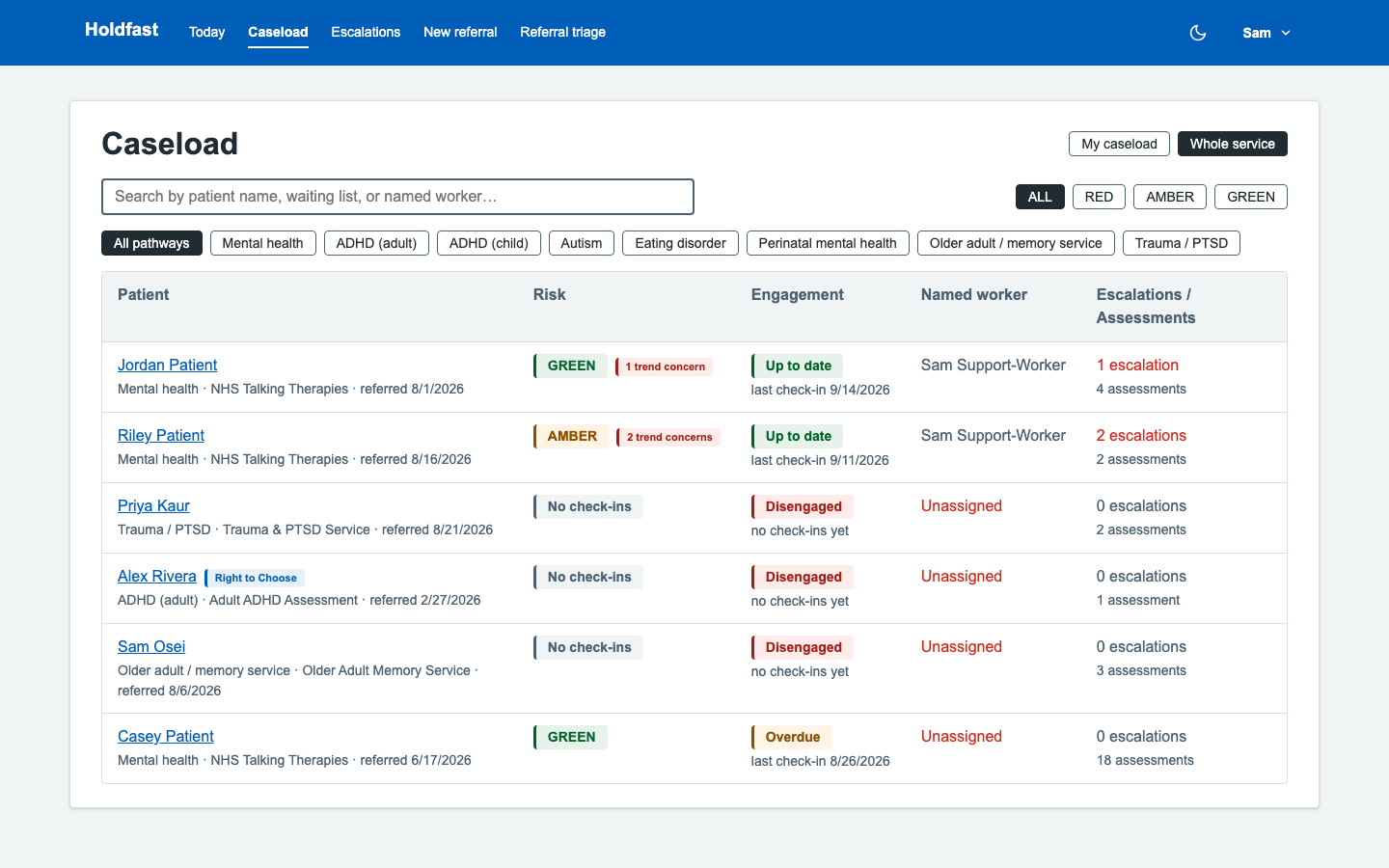
A risk-sorted caseload for your private mental health, ADHD and autism patients. Patients complete the standard questionnaires your clinicians already use; every response is scored against explainable clinical rules, and rising risk escalates to a named clinician with a full audit trail, so one clinician can safely cover more patients.
A clinical tool, not another wellbeing app
Consumer wellbeing apps sit outside your clinical pathway. Holdfast sits inside it: the referral, the clinician, the escalation and the record all live in one place, and your clinical team is the customer.
Built for your clinicians
A risk-sorted caseload and escalation queue for every clinician. The patient app is the channel that feeds them.
Standard clinical instruments
PHQ-9, GAD-7, CORE-10, ASRS, AQ-10 and more, scored against named rules. Self-help is never the response to risk.
A defensible record
Every escalation has a named owner and an audit trail, the evidence insurers and regulators increasingly expect.
Between-session monitoring is expected, and hard to staff for
Insurers, regulators and patients now expect a service to watch for deterioration between paid sessions, not just bill for them. Building that in-house costs engineering time; paper or spreadsheets don't scale and leave no defensible record.
Holdfast is the same operational layer built for NHS Trusts, made available to private organisations directly - your patients, your clinicians, your branding, on infrastructure already built to hold sensitive health data safely and prove it.
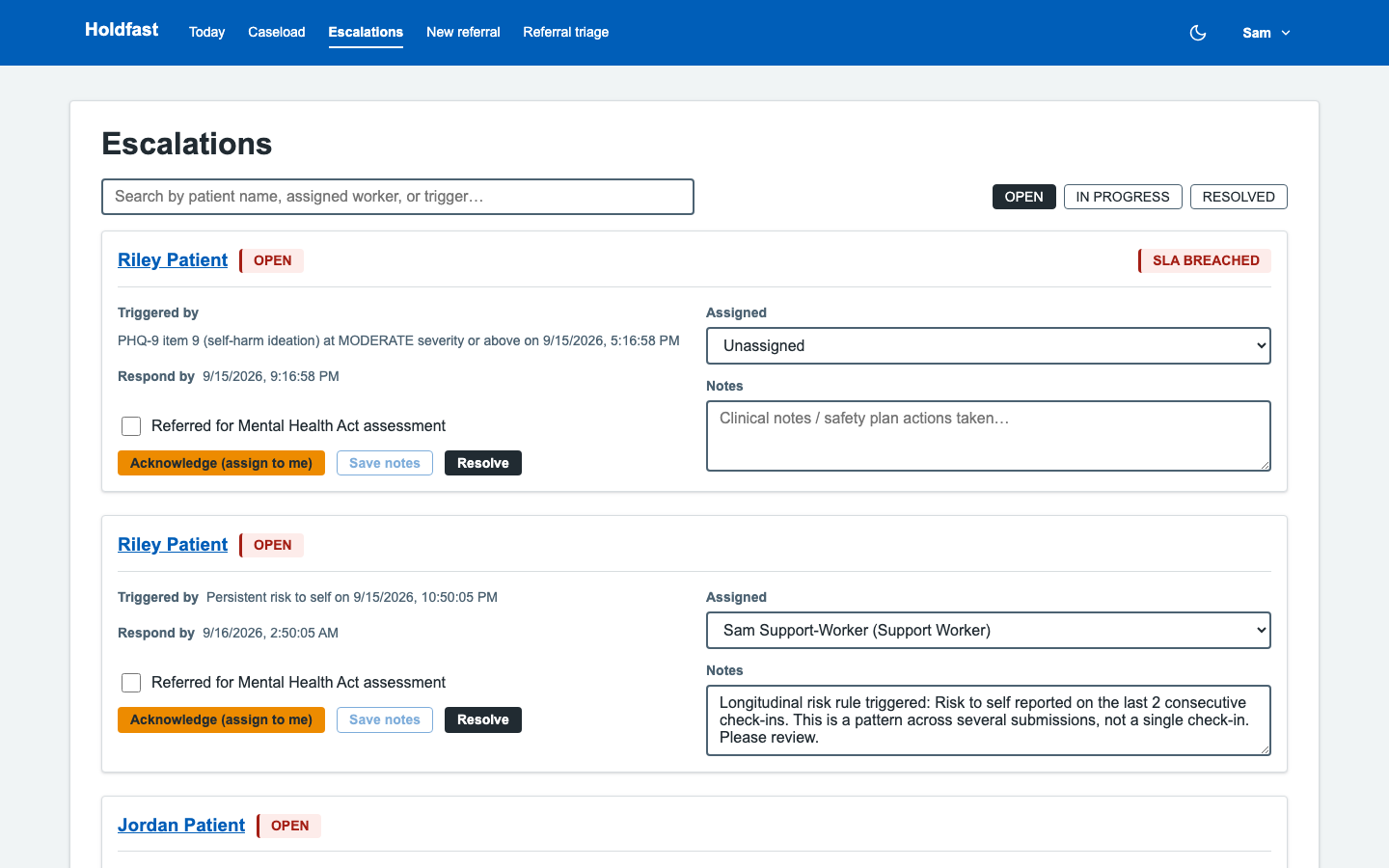
One view, risk-sorted, across every clinician's caseload
A short check-in - mood, sleep, coping, a direct risk-disclosure question - is scored against named, published clinical rules, never a black box. Your caseload sorts itself by who needs attention next.
Escalation with a named owner, every time
Crossing a threshold raises an escalation to the patient's named clinician automatically - never an unread notification in a shared inbox. Every state change is written to an audit log.
Built pathway by pathway, not just for general mental health
Holdfast digitises the same published questionnaires your clinicians already use for intake and outcomes, scored automatically and routed straight to the assessing clinician.
Mental health
CORE-10, WSAS, AUDIT-C, PHQ-9 and GAD-7 on a cadence you set per patient.
Adult ADHD
ASRS screening, digitised, alongside the same risk-monitoring loop.
Child ADHD
SNAP-IV, completed by a parent or carer through their own login.
Autism
AQ-10, in adult, adolescent and child variants.
Older adult & memory services
6-CIT, DAST-10 and GDS-15 depression tracking on a regular cadence.
Perinatal & trauma
EPDS for perinatal depression and PCL-5 for trauma symptoms, on the same escalation loop.
Every form and check-in Holdfast covers
Browse every questionnaire, screener and check-in Holdfast supports, grouped by pathway, with who completes each one and how it is scored and used. The same published instruments your clinicians already know.
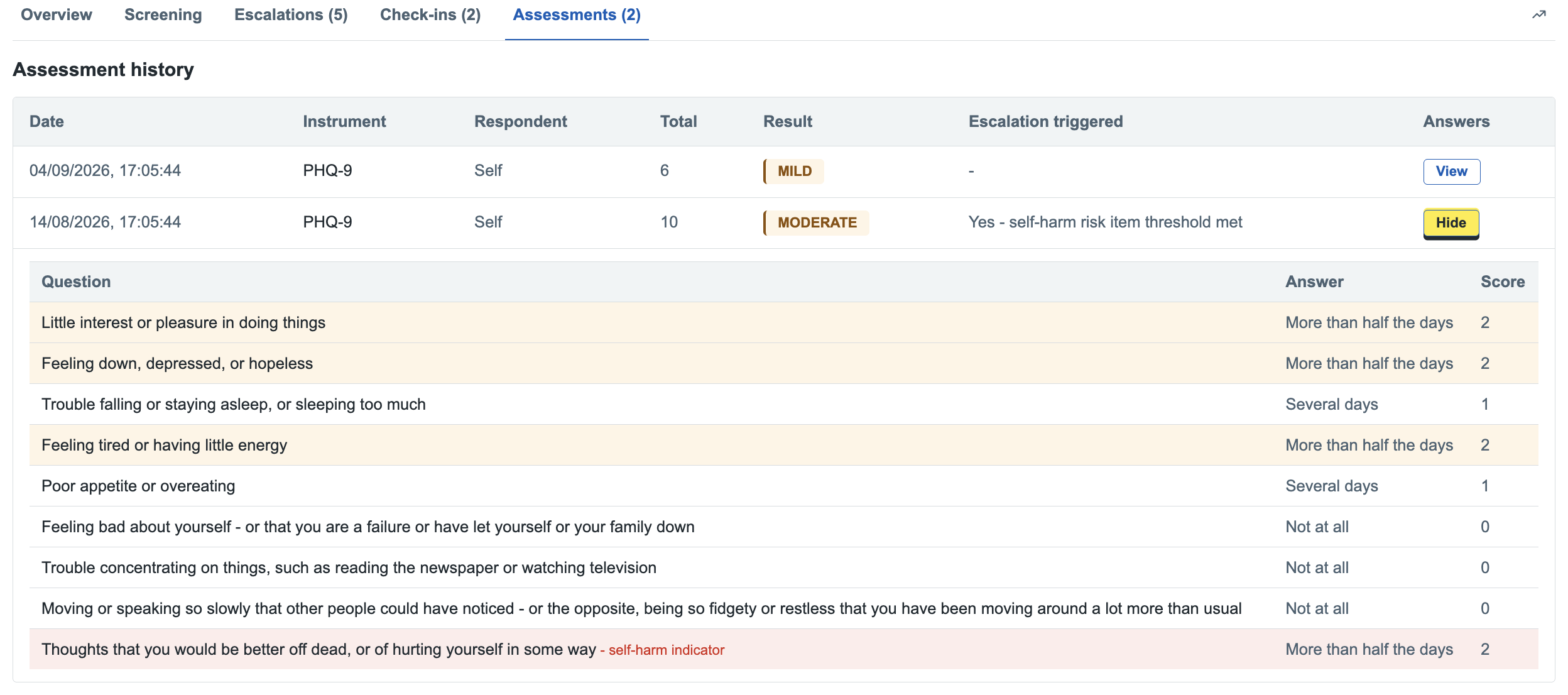
Every answer scored, risky ones flagged
Each questionnaire opens to a full item-by-item breakdown - every question, answer and score - so a clinician can see exactly why a result landed where it did. High-risk items, like the PHQ-9 self-harm question, can trigger an escalation to the named clinician on their own.
Scores are kept against each patient over time, giving you outcome measures for intake, review and discharge without separate paperwork.
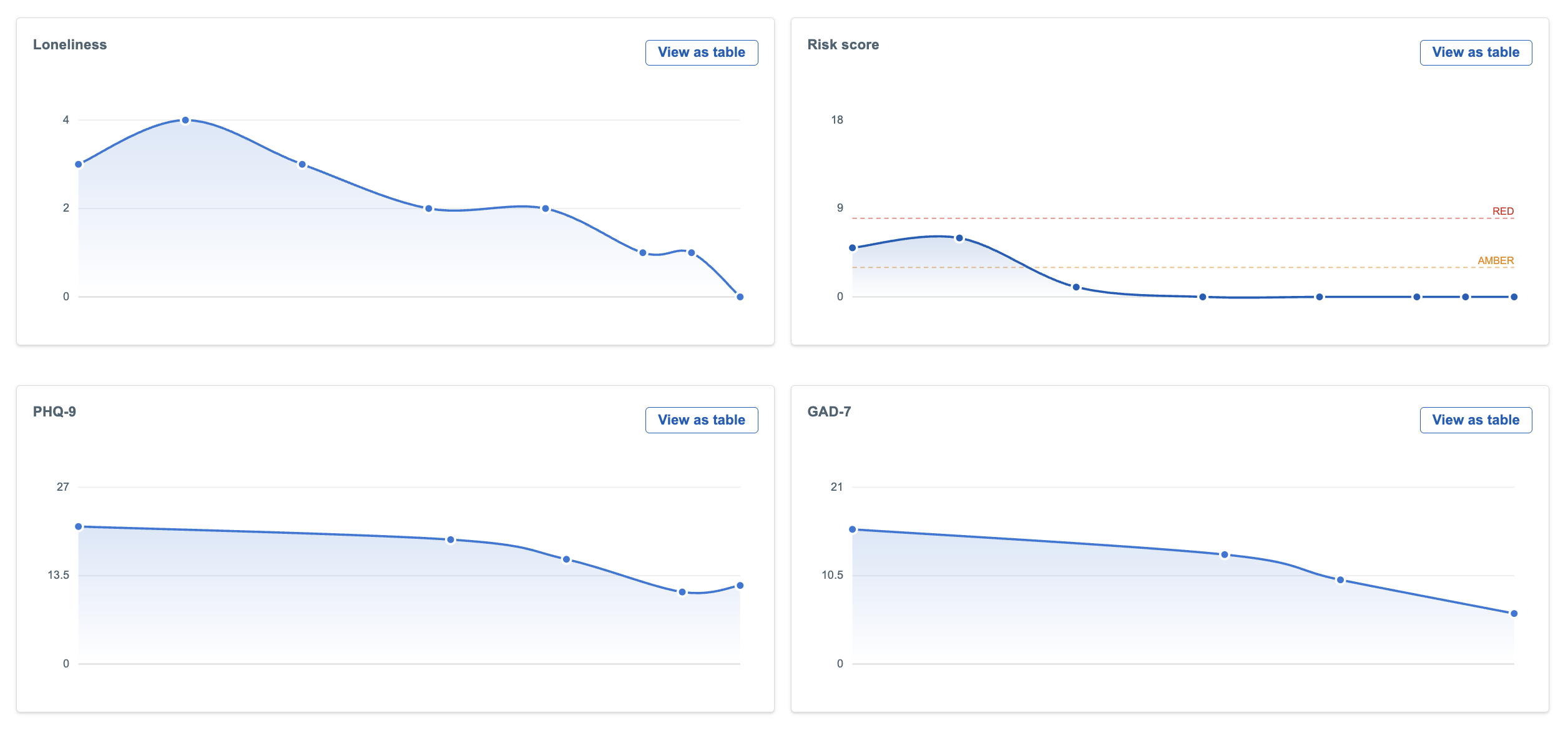
A defensible record, not just a dashboard
Every check-in, score, escalation and clinician action is timestamped and kept - evidence for an insurer, a CQC inspection, or an incident review, without reconstructing it from memory. Every score traces back to a named rule.
This is the same clinical-safety discipline built for NHS deployment - a hazard log, a named clinical safety reviewer, tested scoring logic - running underneath your service too.
Security and compliance evidence, built in from day one
A system that scores clinical risk and holds patient data has to earn its place, private or NHS. Holdfast's controls are documented against the frameworks your governance, insurers or regulators will ask about, with live evidence in-product - not a PDF at contract signing.
Class I medical device
Self-assessed as a Class I medical device under UK MDR 2002: it prioritises and notifies, but never diagnoses or treats without a human in the loop - the same assessment whether the patient is NHS-referred or privately funded.
Data protection
A self-assessed Data Protection Impact Assessment covering lawful basis, individual rights and a scored risk register - with a private-sector variant prepared alongside any private onboarding, not an afterthought.
Who it's for, and what each seat sees
Support worker
Owns a caseload, manages carer contacts, first responder to escalations.
Clinician
Reviews escalations, sets check-in cadence, authors safety plans.
Admin
Manages clinics, teams and staff; sees the audit trail and security evidence.
Clinical Safety Officer
Read-only seat reviewing the hazard log and safety case - the same discipline an NHS Clinical Safety Officer applies.
Practice manager
Read-only, aggregate outcomes reporting - never patient-identifiable data.
Patient & carer
A short, private check-in; a carer's login covers just their patient.
Why this exists
The founder
Holdfast is built by a solution architect and software developer working across digital healthcare and mental health - who started this after watching structured questionnaire scores move between appointments with nobody clinical able to see the pattern until the next one, sometimes months away.
Building it for private providers too came from the same question: who's actually watching for deterioration in the gap between contact, and what happens if nobody is?
Get in touch
Running a private mental health, ADHD or autism service? We'd like to hear from you.
info@holdfasthub.co.uk