Clinical waiting-list management for NHS Trusts, ICBs & VCSE providers
Rheoli rhestrau aros yn glinigol ar gyfer Ymddiriedolaethau GIG, Byrddau Iechyd Integredig (ICBs) a darparwyr VCSE
See who on your waiting list is getting worse,
before they reach crisis.
Gwelwch pwy ar eich rhestr aros sy'n gwaethygu, cyn iddynt gyrraedd argyfwng.
A risk-sorted caseload for every mental health, ADHD and autism waiting list. Patients complete the standard questionnaires services already use; every response is scored against explainable clinical rules, and rising risk escalates to a named worker with a full audit trail.
Llwyth achosion wedi'i ddidoli yn ôl risg ar gyfer pob rhestr aros iechyd meddwl, ADHD ac awtistiaeth. Mae cleifion yn cwblhau'r holiaduron safonol y mae gwasanaethau eisoes yn eu defnyddio; caiff pob ateb ei sgorio yn erbyn rheolau clinigol eglur, ac mae risg gynyddol yn dwysáu at weithiwr penodedig gyda thrywydd archwilio llawn.
A clinical tool, not another wellbeing app
Offeryn clinigol, nid ap llesiant arall
Consumer wellbeing apps sit outside the clinical pathway. Holdfast sits inside it: the referral, the clinician, the escalation and the record all live in one place, and the care team is the customer.
Mae apiau llesiant i ddefnyddwyr y tu allan i'r llwybr clinigol. Mae Holdfast y tu mewn iddo: mae'r atgyfeiriad, y clinigwr, y dwysâd a'r cofnod i gyd mewn un lle, a'r tîm gofal yw'r cwsmer.
Built for the care team
Wedi'i adeiladu ar gyfer y tîm gofal
Clinicians and support workers work from a risk-sorted caseload, an escalation queue and a daily worklist. The patient app is the channel that feeds them.
Mae clinigwyr a gweithwyr cymorth yn gweithio o lwyth achosion wedi'i ddidoli yn ôl risg, ciw dwysadau a rhestr waith ddyddiol. Ap y claf yw'r sianel sy'n eu bwydo.
Standard clinical instruments
Offerynnau clinigol safonol
PHQ-9, GAD-7, CORE-10, ASRS, AQ-10 and more, scored against named rules a Clinical Safety Officer can read. Self-help is never the response to risk.
PHQ-9, GAD-7, CORE-10, ASRS, AQ-10 a mwy, wedi'u sgorio yn erbyn rheolau penodedig y gall Swyddog Diogelwch Clinigol eu darllen. Nid hunangymorth yw'r ymateb i risg byth.
Accountable by design
Atebol drwy ddyluniad
Every escalation has a named owner, a respond-by time and an audit trail. Commissioners get aggregate wait and outcome reporting, never patient data.
Mae gan bob dwysâd berchennog penodedig, amser ymateb a thrywydd archwilio. Mae comisiynwyr yn cael adroddiadau cyfanredol ar aros a chanlyniadau, byth ddata cleifion.
The waiting list is a clinical blind spot
Mae'r rhestr aros yn ddall yn glinigol
42%
42%
of mental health patients say their condition deteriorated while waiting
o gleifion iechyd meddwl yn dweud bod eu cyflwr wedi gwaethygu tra roeddent yn aros
Source: CQC survey, cited via Anxious Minds
Ffynhonnell: arolwg CQC, a ddyfynnwyd drwy Anxious Minds
40%
40%
of waitlisted patients received no support at all during the wait
o gleifion ar restr aros heb dderbyn unrhyw gymorth o gwbl yn ystod yr aros
Source: Rethink, NHS data analysis (2025)
Ffynhonnell: Rethink, dadansoddiad data'r GIG (2025)
2+ years
2+ flynedd
typical wait for an ADHD assessment in England, some areas over 10 years
amser aros nodweddiadol am asesiad ADHD yn Lloegr, dros 10 mlynedd mewn rhai ardaloedd
Source: NHS England, ADHD Taskforce report
Ffynhonnell: GIG Lloegr, adroddiad Tasglu ADHD
Untracked deterioration leads to crises and costlier care later. Holdfast sorts the list by risk automatically, so the same staff can safely support more people - and catch decline before it becomes a crisis, not by chance.
Mae gwaethygu heb ei olrhain yn arwain at argyfyngau a gofal drytach yn nes ymlaen. Mae Holdfast yn didoli'r rhestr yn ôl risg yn awtomatig, fel y gall yr un staff gefnogi mwy o bobl'n ddiogel - a dal dirywiad cyn iddo droi'n argyfwng, nid ar hap.
Who needs you today, and why
Pwy sydd eich angen heddiw, a pham
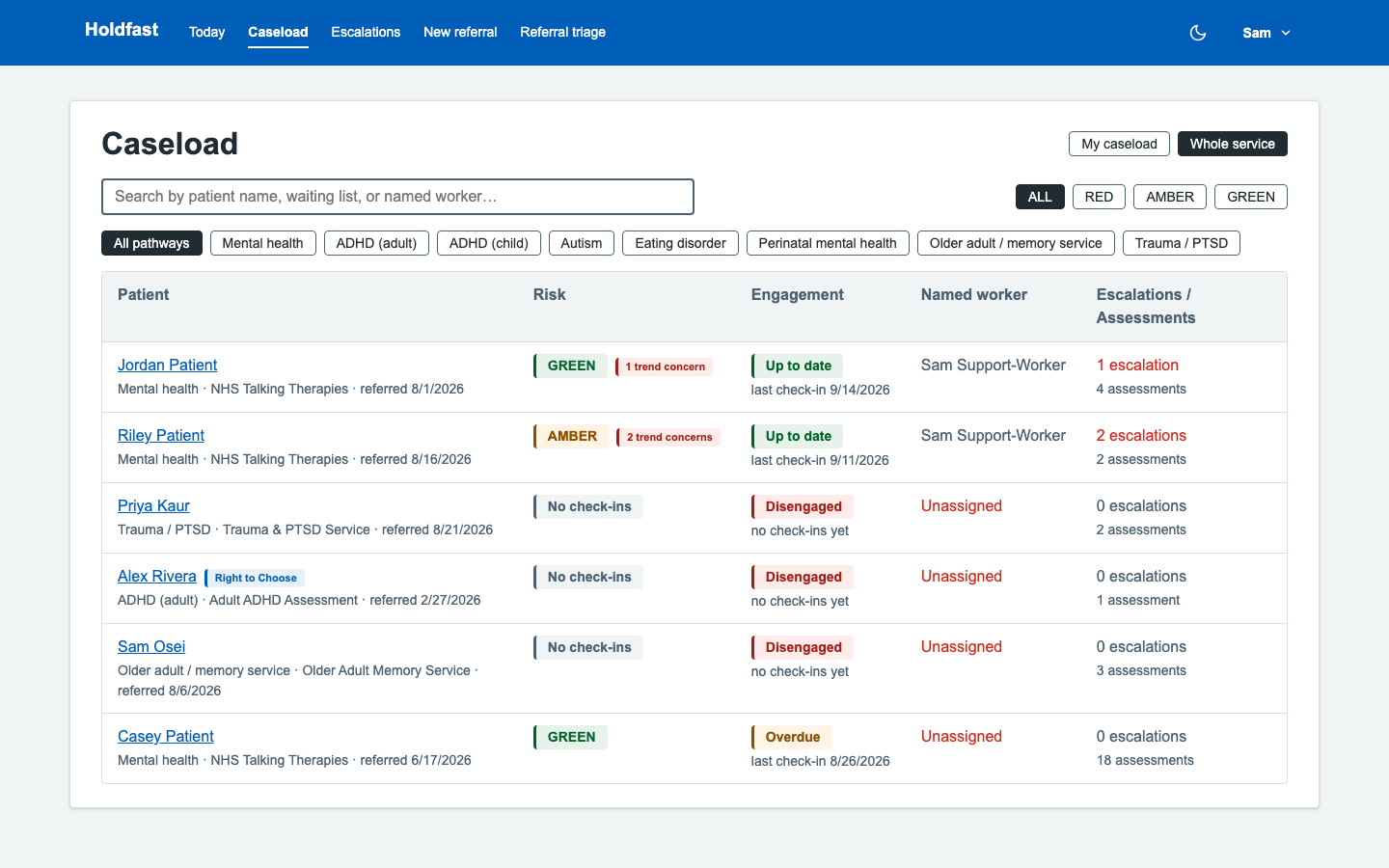
A worker opens their caseload and sees who needs them next - filtered by risk, pathway, and who's gone quiet. No spreadsheet, no manual triage.
Mae gweithiwr yn agor ei lwyth achosion ac yn gweld pwy sydd angen sylw nesaf - wedi'i hidlo yn ôl risg, llwybr, a phwy sydd wedi mynd yn dawel. Dim taenlen, dim brysbennu â llaw.
The daily worklist
Y rhestr waith ddyddiol
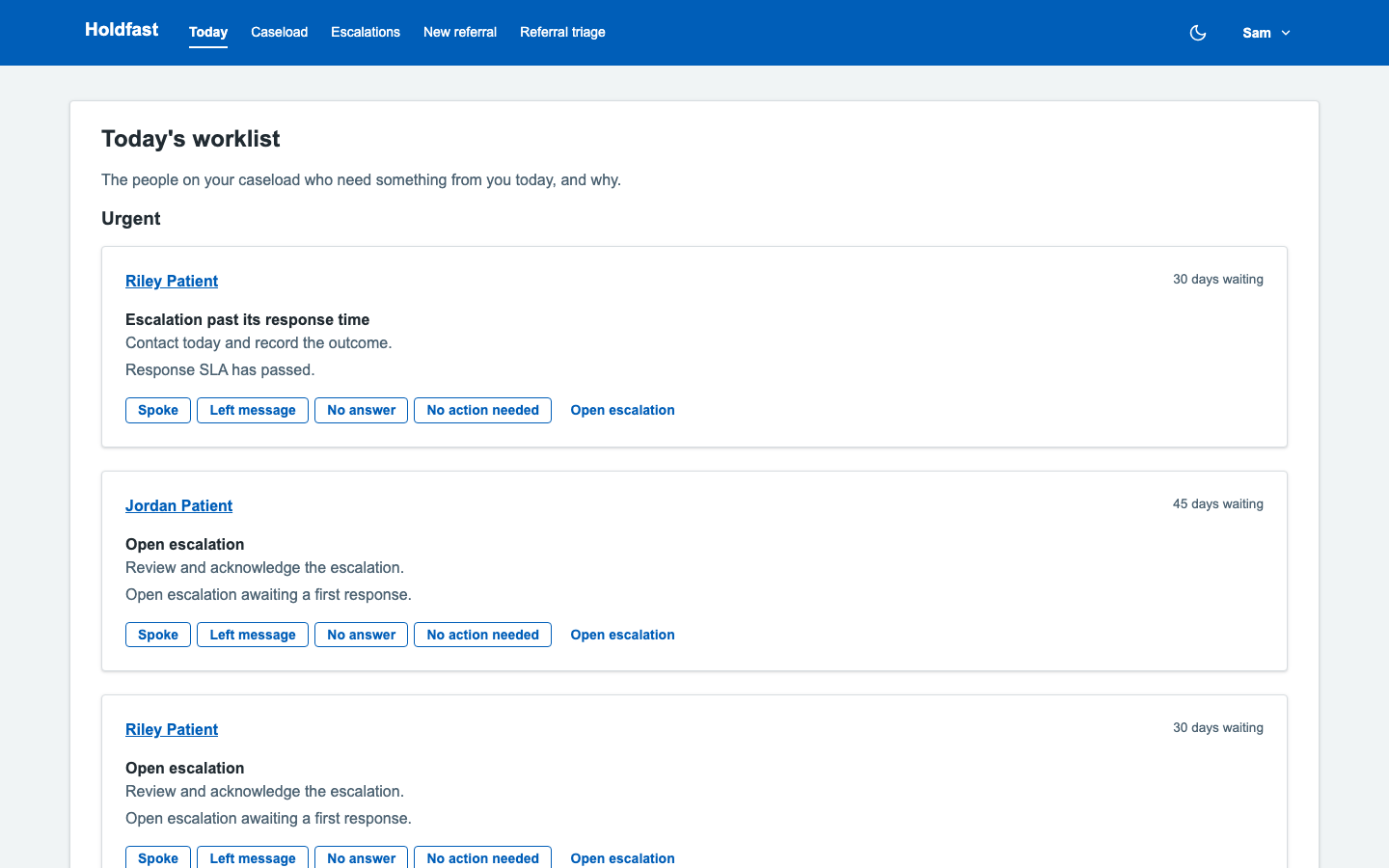
Who to contact today, why, and a one-tap outcome. Every contact becomes reportable outreach activity. Enabled per ICB.
Pwy i gysylltu â nhw heddiw, pam, a chanlyniad ag un tap. Mae pob cyswllt yn dod yn weithgarwch allgymorth y gellir ei adrodd. Wedi'i alluogi fesul ICB.
Escalations that land with a named owner
Dwysadau sy'n cyrraedd perchennog penodedig
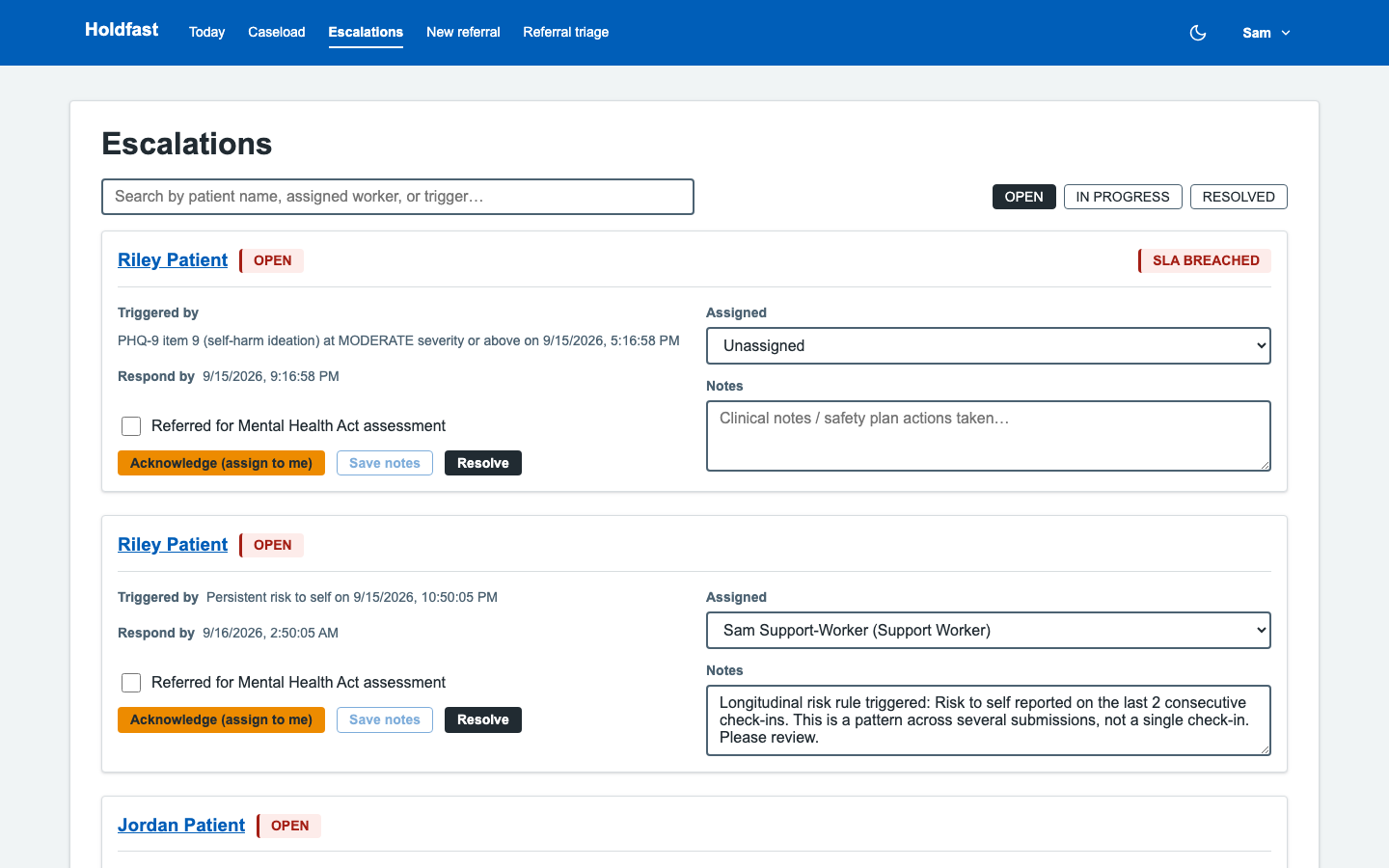
When risk crosses a threshold, the escalation states exactly what triggered it, who owns it and when a response is due. Missed response times are flagged, and re-notified, not left in an inbox.
Pan fydd risg yn croesi trothwy, mae'r dwysâd yn nodi'n union beth a'i sbardunodd, pwy sy'n berchen arno a phryd mae ymateb yn ddyledus. Caiff amseroedd ymateb a fethwyd eu fflagio a'u hailhysbysu, nid eu gadael mewn mewnflwch.
Workers acknowledge, add clinical notes, record a Mental Health Act assessment referral and resolve, and every step is written to the audit log.
Mae gweithwyr yn cydnabod, yn ychwanegu nodiadau clinigol, yn cofnodi atgyfeiriad asesiad Deddf Iechyd Meddwl ac yn datrys, a chaiff pob cam ei ysgrifennu i'r cofnod archwilio.
The trend, not just the last answer
Y duedd, nid dim ond yr ateb diwethaf
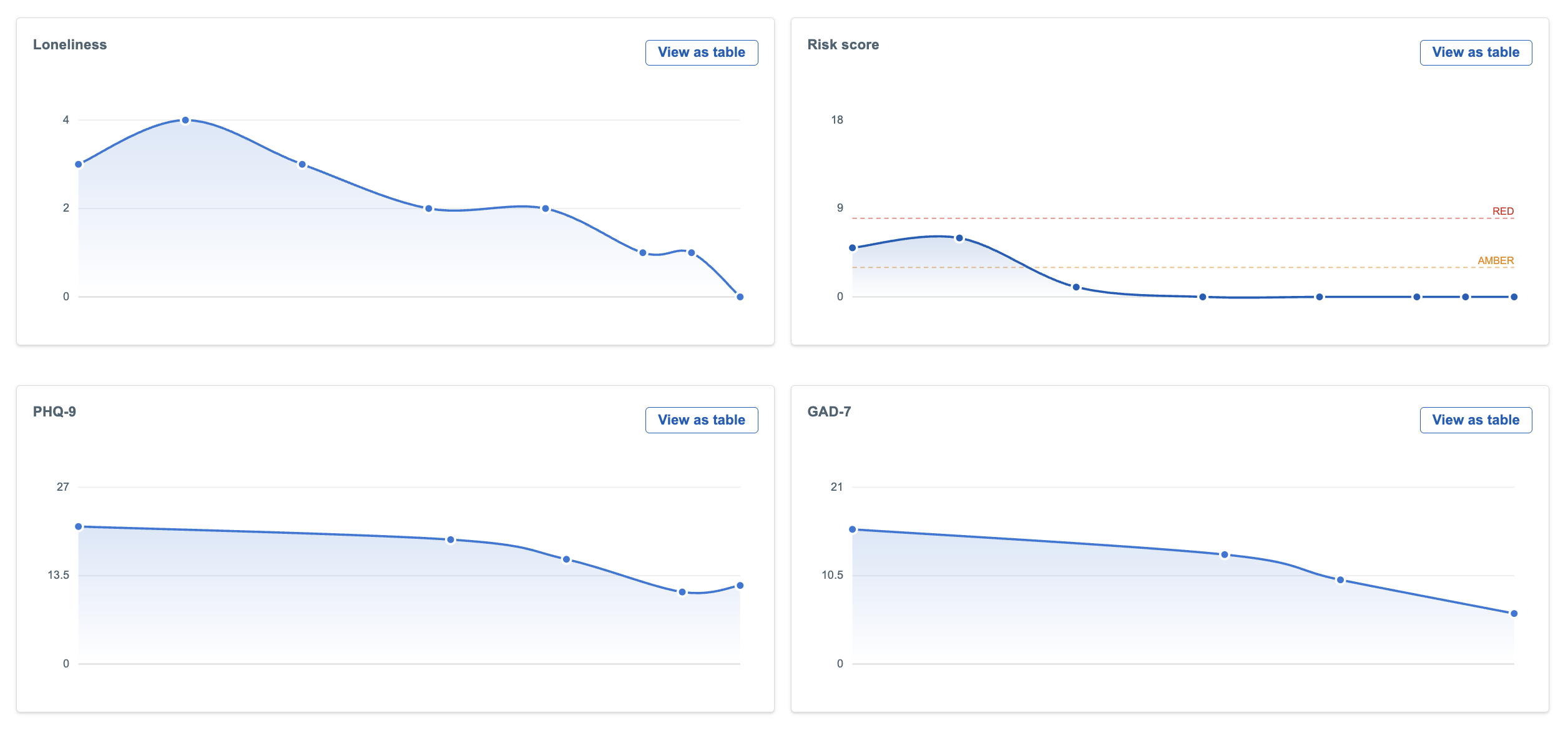
Every measure a patient has given is plotted over time - mood, risk score, PHQ-9, GAD-7 - months before their next appointment.
Caiff pob mesur y mae claf wedi'i roi ei blotio dros amser - hwyliau, sgôr risg, PHQ-9, GAD-7 - fisoedd cyn eu penodiad nesaf.
These charts are what the trend rules watch: a climbing score, a sliding rating, repeated amber results. Each can raise a review on its own, and every chart drops to a plain table.
Dyma'r hyn y mae'r rheolau tuedd yn ei wylio: sgôr yn dringo, graddfa'n llithro, canlyniadau ambr dro ar ôl tro. Gall pob un godi adolygiad ar ei ben ei hun, ac mae pob siart yn gostwng i dabl plaen.
How it fits how the NHS is actually organised
Sut mae'n cyd-fynd â sut mae'r GIG wedi'i drefnu mewn gwirionedd
A Trust runs the platform, an ICB commissions it, and each clinical team keeps its own caseload. Every layer is a real data boundary, not just a filter.
Mae Ymddiriedolaeth yn rhedeg y platfform, mae ICB yn ei gomisiynu, a phob tîm clinigol yn cadw ei lwyth achosion ei hun. Mae pob haen yn ffin ddata go iawn, nid dim ond hidlydd.
England's 36 ICBs (down from 42) each stay their own commissioning boundary in Holdfast, matching real funding agreements. An administrator can add a new Trust, its ICBs and teams, and invite staff, in minutes.
Mae pob un o 36 Bwrdd Iechyd Integredig Lloegr (i lawr o 42) yn aros yn ffin gomisiynu ar wahân yn Holdfast, gan gyd-fynd â chytundebau ariannu go iawn. Gall gweinyddwr ychwanegu Ymddiriedolaeth newydd, ei Byrddau Iechyd Integredig a'i thimau, a gwahodd staff, mewn munudau.
Nothing starts without consent. Every patient gives explicit, withdrawable consent before their first check-in. Equity data is optional and always reported anonymously.
Ni fydd dim yn dechrau heb gydsyniad. Mae pob claf yn rhoi cydsyniad eglur, y gellir ei dynnu'n ôl, cyn ei gofnod cyntaf. Mae data tegwch yn ddewisol a chaiff ei adrodd yn ddienw bob amser.
Built for every waiting list, not just one
Wedi'i adeiladu ar gyfer pob rhestr aros, nid dim ond un
ADHD, autism, memory and trauma pathways wait just as long, tracked mostly on paper. Holdfast digitises the same standard questionnaires services already trust, routed straight to the assessing clinician.
Mae llwybrau ADHD, awtistiaeth, cof a thrawma yn aros yr un mor hir, wedi'u holrhain ar bapur gan mwyaf. Mae Holdfast yn digido'r un holiaduron safonol y mae gwasanaethau eisoes yn ymddiried ynddynt, wedi'u llwybro'n syth at y clinigwr sy'n asesu.
Mental health
Iechyd meddwl
CORE-10, WSAS, AUDIT-C, PHQ-9 and GAD-7 on a regular check-in cadence.
CORE-10, WSAS, AUDIT-C, PHQ-9 a GAD-7 ar gyflymder cofnodi rheolaidd.
Adult ADHD
ADHD Oedolion
ASRS screening, digitised, with the same risk-monitoring loop.
Sgrinio ASRS, wedi'i ddigido, gyda'r un ddolen monitro risg.
Child ADHD
ADHD Plant
SNAP-IV, completed by a parent or carer through their own login.
SNAP-IV, wedi'i gwblhau gan riant neu ofalwr drwy eu mewngofnodiad eu hunain.
Autism
Awtistiaeth
AQ-10, in adult, adolescent and child variants.
AQ-10, mewn fersiynau oedolion, glaslanciau a phlant.
Older adult & memory services
Oedolion hŷn a gwasanaethau cof
6-CIT, DAST-10 and GDS-15 for the memory-service backlog.
6-CIT, DAST-10 a GDS-15 ar gyfer ôl-groniad gwasanaethau cof.
Trauma & PTSD
Trawma ac PTSD
TSQ for quick triage, or PCL-5 for full severity detail.
TSQ ar gyfer brysbennu cyflym, neu PCL-5 am fanylder difrifoldeb llawn.
Every form and check-in Holdfast covers
Pob ffurflen a chofnod, mewn un lle
Browse every questionnaire, screener and check-in Holdfast supports, grouped by pathway, with who completes each one and how it is scored and used.
Porwch drwy bob holiadur, sgrinydd a chofnod y mae Holdfast yn eu cefnogi, wedi'u grwpio yn ôl llwybr, gyda phwy sy'n cwblhau pob un a sut y caiff ei sgorio a'i ddefnyddio.
That turns an invisible backlog into a reportable figure, pathway by pathway. See how a carer completes a check-in, or a clinician raises a one-off screener.
Mae hynny'n troi ôl-groniad anweledig yn ffigwr y gellir ei adrodd, lwybr wrth lwybr. Gweler sut mae gofalwr yn cwblhau cofnod, neu sut mae clinigwr yn codi sgrinio untro.
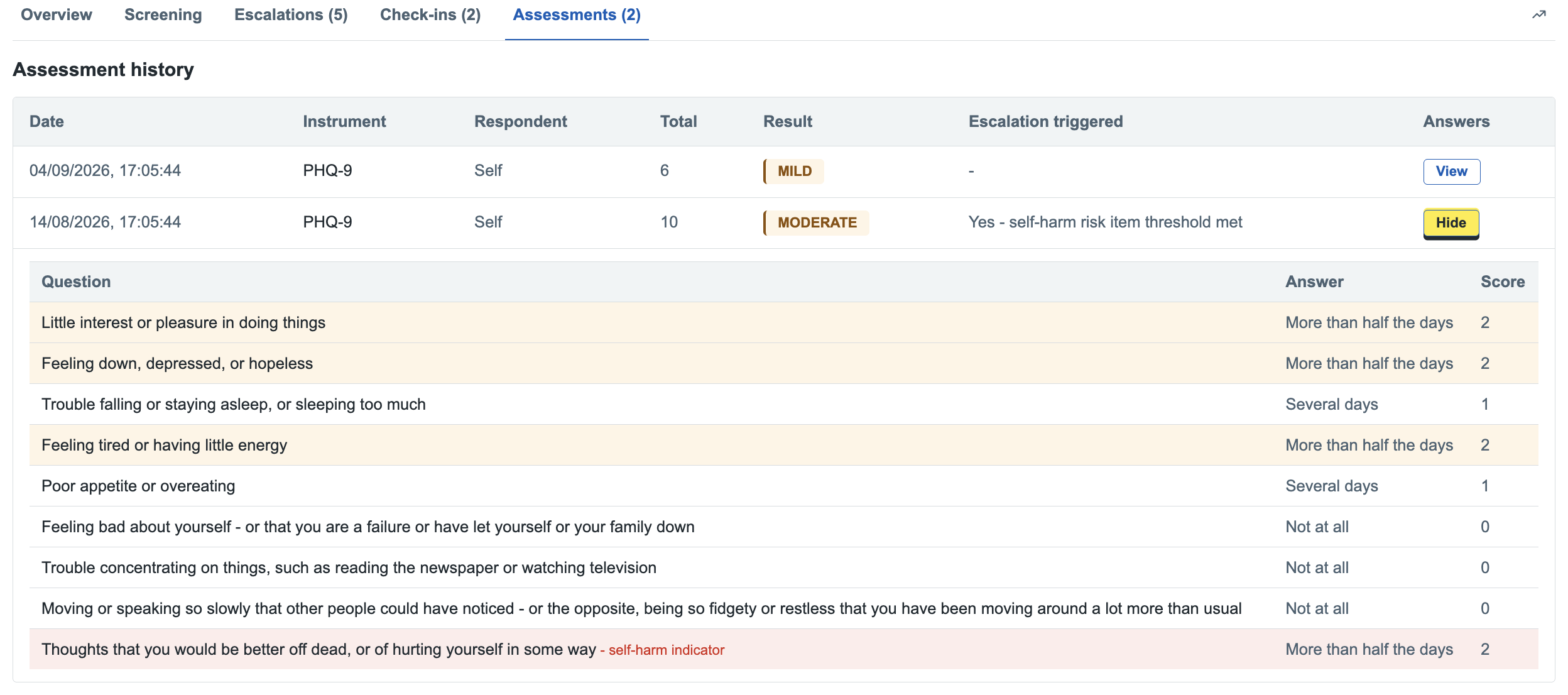
Every answer scored, risky ones flagged
Pob ateb wedi'i sgorio, a'r rhai peryglus wedi'u fflagio
Each questionnaire opens to a full item-by-item breakdown - every question, answer and score. High-risk items, like the PHQ-9 self-harm question, can trigger an escalation on their own.
Mae pob holiadur yn agor i ddadansoddiad llawn fesul eitem - pob cwestiwn, ateb a sgôr. Gall eitemau risg uchel, fel cwestiwn hunan-niwed y PHQ-9, sbarduno dwysâd ar eu pen eu hunain.
Compliance evidence, built in from day one
Tystiolaeth cydymffurfiaeth, wedi'i hadeiladu i mewn o'r diwrnod cyntaf
A system holding patient data has to earn its place in the NHS. Holdfast maps its controls to the frameworks procurement teams assess against, with live evidence in-product - not a PDF at contract signing.
Rhaid i system sy'n dal data cleifion ennill ei lle yn y GIG. Mae Holdfast yn mapio ei reolaethau i'r fframweithiau y mae timau caffael yn asesu yn eu herbyn, gyda thystiolaeth fyw yn y cynnyrch - nid PDF wrth arwyddo contract.
DTACDTAC
The standard NHS gate for digital health tools. Every control is tagged against DTAC's sections, ready for an assessor to trace.
Y giât safonol y GIG ar gyfer offer iechyd digidol. Mae pob rheolaeth wedi'i thagio yn erbyn adrannau DTAC, yn barod i aseswr ei holrhain.
DPIADPIA
Required wherever special category health data is processed at this scale. Holdfast's self-assessed DPIA covers lawful basis, individual rights and a scored risk register.
Yn ofynnol lle bynnag y caiff data iechyd categori arbennig ei brosesu ar y raddfa hon. Mae DPIA hunanasesedig Holdfast yn cwmpasu sail gyfreithlon, hawliau unigolion a chofrestr risg sgoriedig.
Class I medical deviceDyfais feddygol Dosbarth I
Self-assessed as a Class I medical device under UK MDR 2002: it prioritises and notifies, but never diagnoses or treats without a human in the loop.
Wedi'i hunanasesu fel dyfais feddygol Dosbarth I o dan UK MDR 2002: mae'n blaenoriaethu ac yn hysbysu, ond byth yn diagnosio na thrin heb berson yn y ddolen.
Read the classification assessmentDarllenwch yr asesiad dosbarthu
DSPTDSPT
The annual self-assessment every NHS data handler must complete. Holdfast's audit logging and tenant isolation give a Trust the evidence its submission needs.
Yr hunanasesiad blynyddol y mae'n rhaid i bob deiliad data'r GIG ei gwblhau. Mae cofnodi archwilio ac ynysu tenant Holdfast yn rhoi'r dystiolaeth sydd ei hangen ar Ymddiriedolaeth.
Cyber Essentials PlusCyber Essentials Plus
Independently verified, not self-assessed - required before any real patient data is processed.
Wedi'i wirio'n annibynnol, nid ei hunanasesu - yn ofynnol cyn prosesu unrhyw ddata claf gwirioneddol.
PCREFPCREF
Expects providers to evidence fair reach across communities. Ethnicity and gender data are optional, patient-supplied, and small-number-suppressed in every report.
Yn disgwyl i ddarparwyr ddangos tystiolaeth o gyrraedd teg ar draws cymunedau. Mae data ethnigrwydd a rhywedd yn ddewisol, wedi'u darparu gan y claf, ac wedi'u hatal lle bo'r rhif yn fach ym mhob adroddiad.
See how consent and equity data are handledGweld sut mae data cydsyniad a thegwch yn cael eu trin
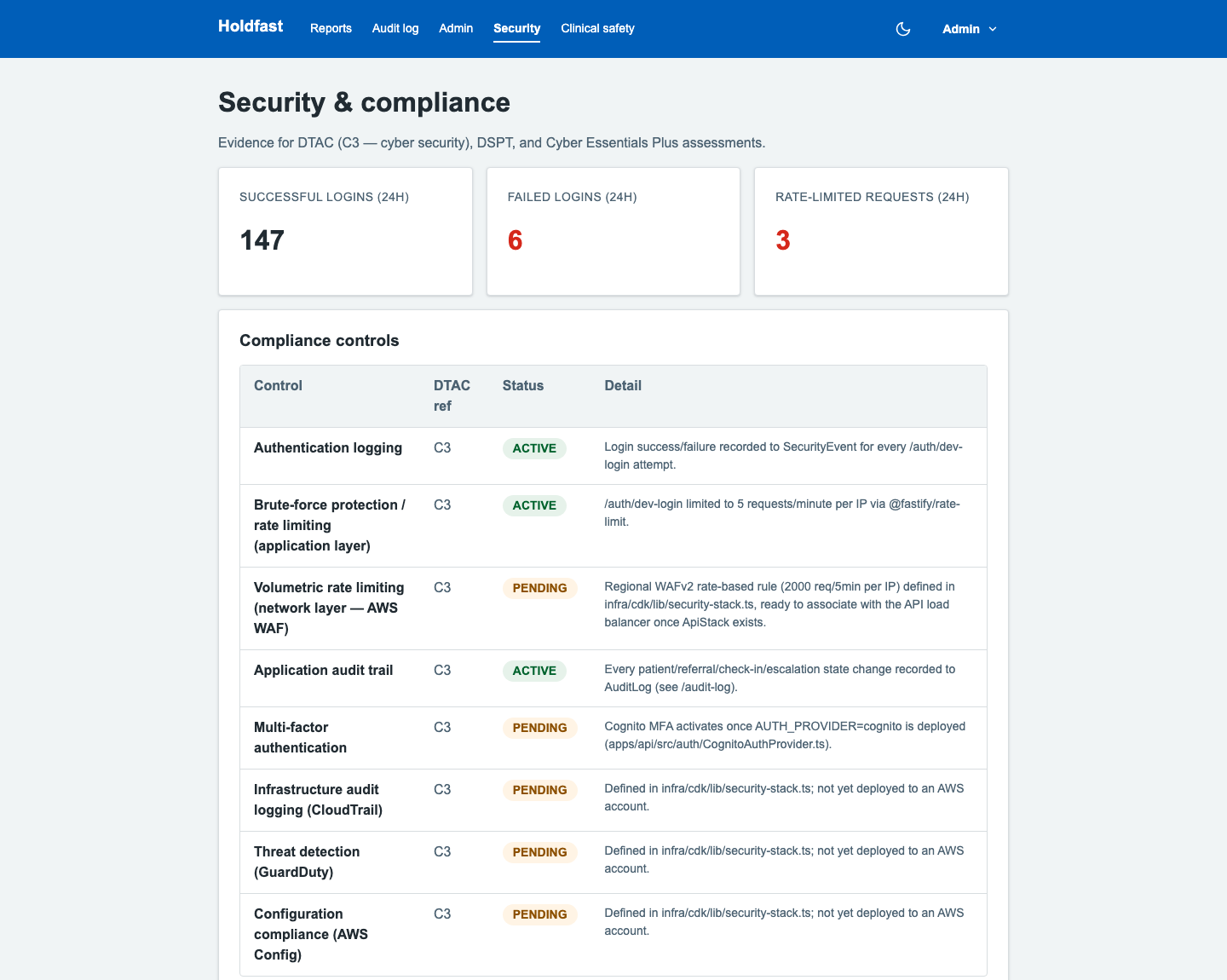
Live control evidence, not a claim in a slide deck
Tystiolaeth reolaeth fyw, nid honiad mewn cyflwyniad sleidiau
An Admin sees exactly which controls are active today and which are queued - nothing marked done that isn't. On the app, a Face ID/passcode lock and jailbreak detection sit in front of the check-in data itself.
Mae Gweinyddwr yn gweld pa reolaethau sy'n weithredol heddiw a pha rai sydd yn y ciw - ni farcir dim yn gyflawn os nad yw. Ar yr ap, mae clo Face ID/cod pas a chanfod jailbreak yn eistedd o flaen data'r cofnod ei hun.
Every state change - consent, a safety plan, an escalation - is written to an immutable audit log with who and when. See what gets logged when a check-in escalates.
Caiff pob newid cyflwr - cydsyniad, cynllun diogelwch, dwysâd - ei ysgrifennu i gofnod archwilio na ellir ei newid, gyda phwy a phryd. Gweler beth gaiff ei gofnodi pan fydd cofnod yn dwysáu.
Clinical safety and information security stay separate on purpose. The Clinical Safety Officer's hazard log is a distinct, read-only view from the Admin's security dashboard.
Mae diogelwch clinigol a diogelwch gwybodaeth yn aros ar wahân yn fwriadol. Mae cofrestr peryglon y Swyddog Diogelwch Clinigol yn olwg wahanol, darllen-yn-unig, oddi wrth ddangosfwrdd diogelwch y Gweinyddwr.
Who it's for, and what each seat sees
Ar gyfer pwy, a beth mae pob sedd yn ei weld
Support worker
Gweithiwr cymorth
Owns a caseload, manages carer contacts, first responder to escalations.
Yn berchen ar lwyth achosion, yn rheoli cysylltiadau gofalwyr, yn ymatebwr cyntaf i ddwysadau.
Clinician
Clinigwr
Reviews escalations, sets check-in cadence, authors safety plans.
Yn adolygu dwysadau, yn gosod cyflymder cofnodi, yn awduro cynlluniau diogelwch.
Admin
Gweinyddwr
Manages teams and staff across an ICB; sees the audit trail.
Yn rheoli timau a staff ar draws ICB; yn gweld y trywydd archwilio.
Clinical Safety Officer
Swyddog Diogelwch Clinigol
Read-only ICB-wide seat reviewing the hazard log and safety case.
Sedd darllen-yn-unig ar draws yr ICB yn adolygu'r gofrestr peryglon a'r achos diogelwch.
Commissioner
Comisiynydd
Read-only, aggregate outcomes and waiting-list reporting - never patient data.
Darllen-yn-unig, canlyniadau cyfanredol ac adrodd rhestr aros - byth ddata cleifion.
Patient & carer
Claf a gofalwr
A short, private check-in; a carer's login covers just their patient.
Cofnod byr, preifat; mae mewngofnodiad gofalwr yn cwmpasu eu claf yn unig.
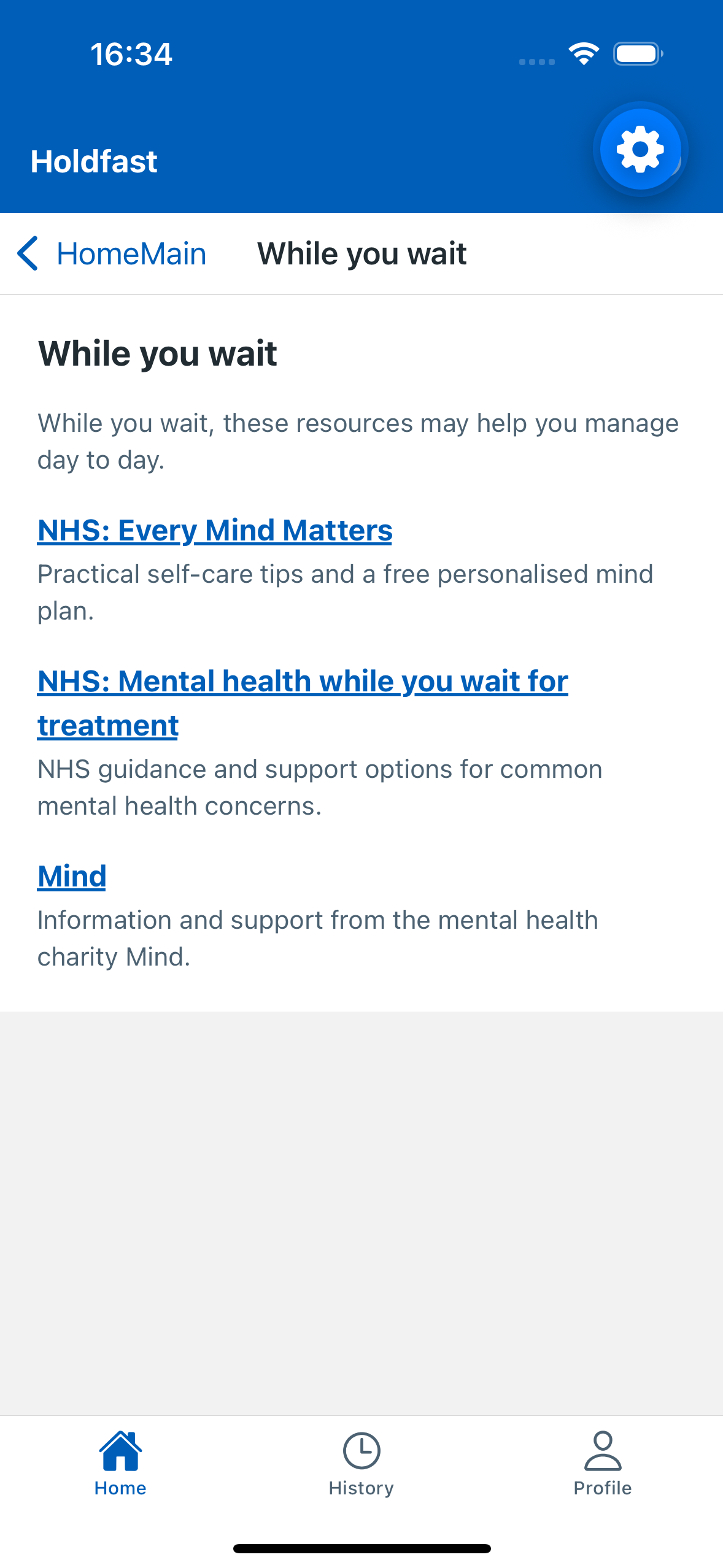
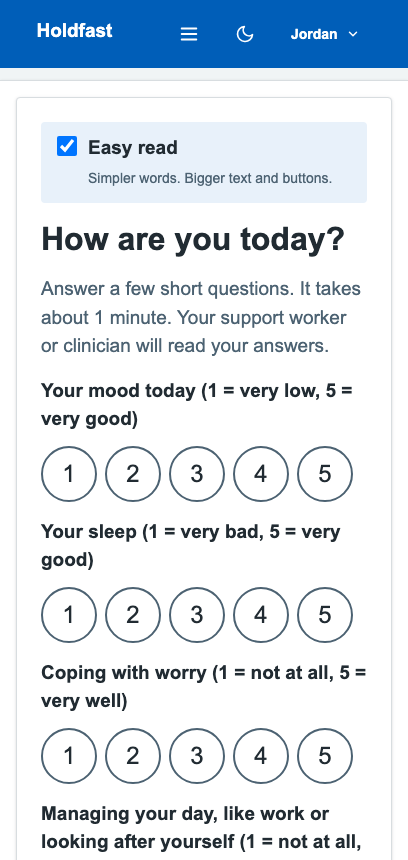
The patient side: something back, not just another form
Ochr y claf: rhywbeth yn ôl, nid dim ond ffurflen arall
Every check-in asks for something. Here's what patients get back while they wait.
Mae pob cofnod yn gofyn rhywbeth. Dyma beth mae cleifion yn ei gael yn ôl tra byddant yn aros.
Waiting Well resources
Adnoddau Aros yn Dda
NHS-approved self-help matched to the patient's pathway and wait - not a generic list.
Hunangymorth a gymeradwywyd gan y GIG wedi'i gyfateb i lwybr ac aros y claf - nid rhestr gyffredinol.
Self-management nudges
Anogiadau hunanreoli
A repeated pattern - poor sleep, rising anxiety - surfaces a specific NHS resource. Rules a Clinical Safety Officer can read; paused while an escalation is open. Per-ICB opt-in.
Mae patrwm ailadroddus - cwsg gwael, pryder cynyddol - yn dangos adnodd GIG penodol. Rheolau y gall Swyddog Diogelwch Clinigol eu darllen; wedi'u hoedi tra bo dwysáu ar agor. Yn ddewisol fesul ICB.
A note from the named worker
Nodyn gan y gweithiwr penodedig
A short templated message - send-only, with a standing link to urgent help. Per-ICB opt-in.
Neges fer o dempled - anfon yn unig, gyda dolen sefydlog i gymorth brys. Yn ddewisol fesul ICB.
NHS Right to Choose
Hawl i Ddewis y GIG
Past the pathway's review threshold, staff get an NHS signposting panel to share - information, not advice. See the full flow.
Ar ôl trothwy adolygu'r llwybr, mae staff yn cael panel cyfeirio o darddiad y GIG i'w rannu - gwybodaeth, nid cyngor. Gweler y llif llawn.
My wellness plan
Fy nghynllun llesiant
A private plan in the patient's own words, shared only when they choose. See the optional add-on.
Cynllun preifat yng ngeiriau'r claf ei hun, wedi'i rannu dim ond pan fyddant yn dewis. Gweler yr ychwanegiad dewisol.
Built for every patient
Wedi'i adeiladu ar gyfer pob claf
Easy-read mode, five languages, and full screen-reader and keyboard support.
Modd hawdd-i'w-ddarllen, pum iaith, a chefnogaeth lawn i ddarllenydd sgrin a bysellfwrdd.
Save and finish later
Cadw a gorffen yn hwyrach
Longer forms autosave as you go, on web and app.
Mae ffurflenni hirach yn cadw'n awtomatig wrth fynd, ar y we a'r ap.
A gentle first run
Cyflwyniad tyner cyntaf
A short intro explains what a check-in is. On the app, Face ID, a fingerprint or a passcode guards the data before anything shows.
Mae cyflwyniad byr yn esbonio beth yw cofnod. Ar yr ap, mae Face ID, ôl bys neu god pas yn gwarchod y data cyn i ddim ymddangos.
Optional add-on
Ychwanegiad dewisol
My wellness plan: the patient's own words, on the record
Fy nghynllun llesiant: geiriau'r claf ei hun, ar y cofnod
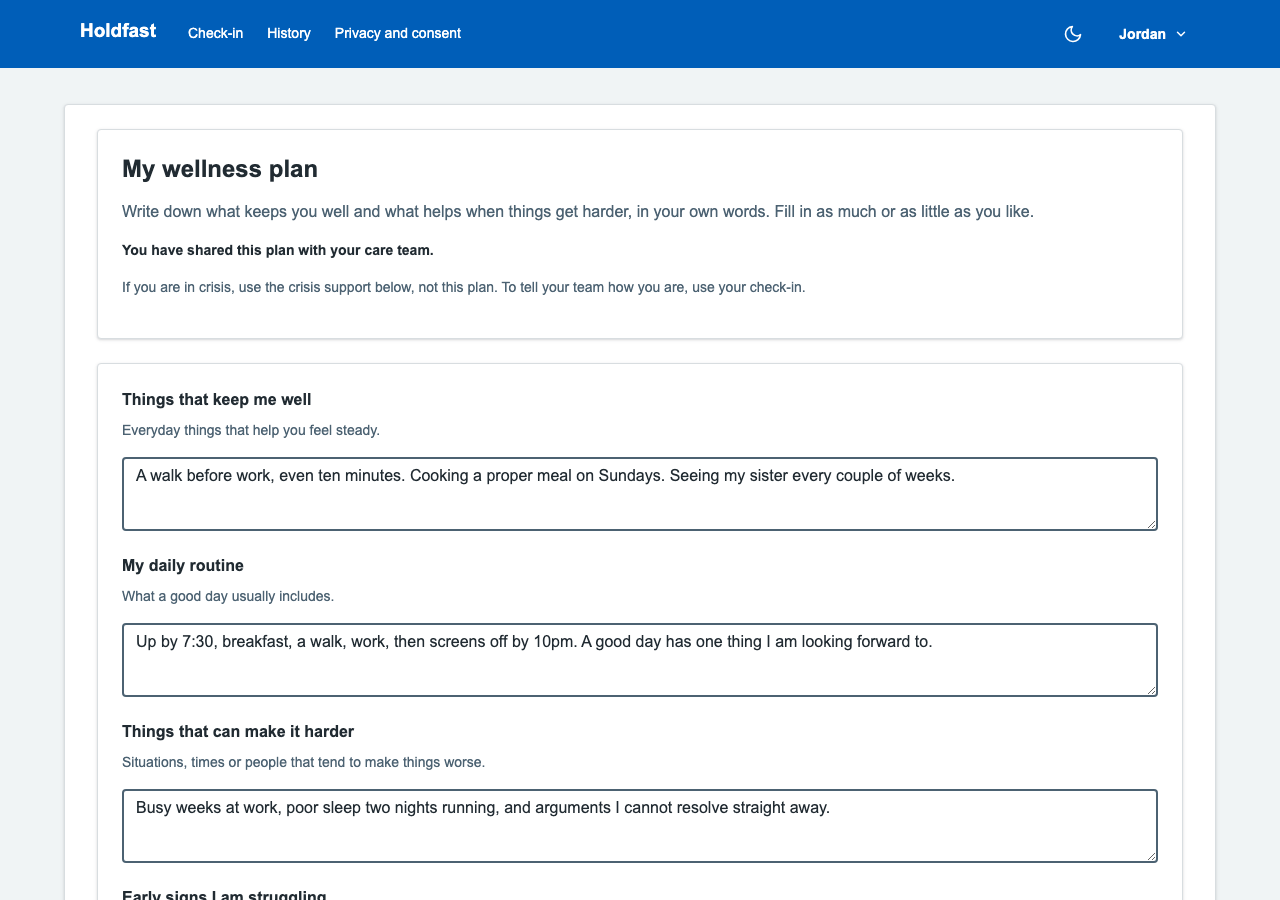
While they wait, patients can write down what keeps them well, what makes things harder, the early signs they are struggling and what helps. It supports care planning - it is not the NHS agreed care plan, and it is never a crisis route.
Wrth aros, gall cleifion ysgrifennu'r hyn sy'n eu cadw'n iach, yr hyn sy'n gwneud pethau'n anoddach, yr arwyddion cynnar eu bod yn cael trafferth a'r hyn sy'n helpu. Mae'n cefnogi cynllunio gofal - nid cynllun gofal y cytunwyd arno gan y GIG mohono, ac nid yw byth yn llwybr argyfwng.
Private until the patient shares it
Preifat nes bod y claf yn ei rannu
A plan starts as a private draft. Sharing needs the patient's data-sharing consent, they can stop at any time, and withdrawing consent makes it private again straight away.
Mae cynllun yn dechrau fel drafft preifat. Mae rhannu angen cydsyniad rhannu data'r claf, gallant roi'r gorau iddi ar unrhyw adeg, ac mae tynnu cydsyniad yn ôl yn ei wneud yn breifat eto ar unwaith.
Their strategies, back at the right moment
Eu strategaethau nhw, yn ôl ar yr adeg iawn
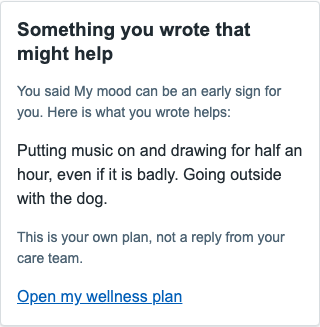
When an area the patient named as an early sign stays low across check-ins, the app shows them what they wrote helps. A fixed rule, visible to a Clinical Safety Officer, that never changes the risk score - and it is withheld whenever there is an open escalation, a RED check-in, any risk to self or a flagged note.
Pan fydd maes a enwyd gan y claf fel arwydd cynnar yn parhau'n isel ar draws cofnodion, mae'r ap yn dangos iddynt yr hyn a ysgrifennwyd ganddynt sy'n helpu. Rheol sefydlog, y gall Swyddog Diogelwch Clinigol ei gweld, nad yw byth yn newid y sgôr risg - ac fe'i hatelir pryd bynnag y mae dwysáu ar agor, cofnod COCH, unrhyw risg i'r hunan neu nodyn wedi'i farcio.
Reviewed with the patient, not edited for them
Wedi'i adolygu gyda'r claf, heb ei olygu drostynt
The named worker reads a shared plan, adds a short note and marks it reviewed. Staff never edit the patient's text, and risk language in a shared plan is flagged for a person to read. A linked carer can help write it, but only the patient shares it.
Mae'r gweithiwr penodedig yn darllen cynllun a rannwyd, yn ychwanegu nodyn byr ac yn ei farcio wedi'i adolygu. Nid yw staff byth yn golygu testun y claf, ac mae iaith risg mewn cynllun a rannwyd yn cael ei marcio i berson ei darllen. Gall gofalwr cysylltiedig helpu i'w ysgrifennu, ond dim ond y claf sy'n ei rannu.
Aggregate view for commissioners
Golwg cyfanredol i gomisiynwyr
Shared and reviewed plans are reported separately, with small numbers hidden and no league table, so the measure cannot be gamed.
Mae cynlluniau a rannwyd ac a adolygwyd yn cael eu hadrodd ar wahân, gyda niferoedd bach wedi'u cuddio a dim tabl cynghrair, fel na ellir chwarae'r mesur.
Per-ICB opt-in, off by default, and not available on child pathways yet.
Yn ddewisol fesul ICB, i ffwrdd yn ddiofyn, ac nid yw ar gael ar lwybrau plant eto.
Why this exists
Pam mae hyn yn bodoli
The founder
Y sylfaenydd
Holdfast is built by a solution architect and software developer working across digital healthcare and mental health - who is also neurodivergent and, after a long wait for formal assessment, decided to build something for everyone else waiting in silence.
Adeiladwyd Holdfast gan bensaer datrysiadau a datblygwr meddalwedd sy'n gweithio ar draws gofal iechyd digidol ac iechyd meddwl - sydd hefyd yn niwroamrywiol ac, ar ôl aros yn hir am asesiad ffurfiol, wedi penderfynu adeiladu rhywbeth i bawb arall sy'n aros mewn distawrwydd.
The evolving solution
Yr ateb sy'n esblygu
It started with filling in PHQ-9 and GAD-7 week after week during CBT: the numbers moved long before anyone clinical saw them. Holdfast closes that gap - keeping the instruments services already trust, but routing them somewhere that acts in real time.
Dechreuodd wrth lenwi PHQ-9 a GAD-7 wythnos ar ôl wythnos yn ystod CBT: symudodd y sgorau ymhell cyn i unrhyw un yn glinigol eu gweld. Mae Holdfast yn cau'r bwlch hwnnw - gan gadw'r offerynnau y mae gwasanaethau eisoes yn ymddiried ynddynt, ond eu llwybro i rywle sy'n gweithredu mewn amser real.
Get in touch
Cysylltwch â ni
Commissioning a mental health, ADHD or autism waiting-list service? We'd like to hear from you.
Yn comisiynu gwasanaeth rhestr aros iechyd meddwl, ADHD neu awtistiaeth? Byddem wrth ein bodd yn clywed gennych.
info@holdfasthub.co.uk info@holdfasthub.co.uk